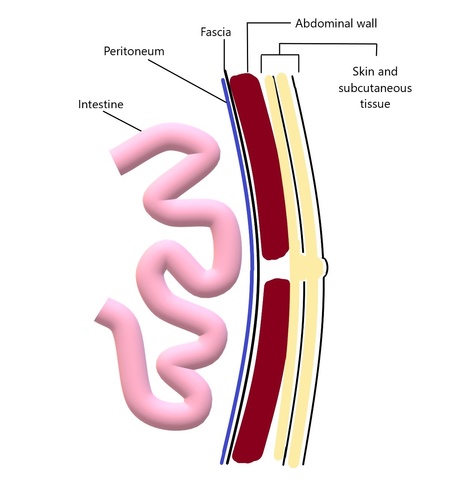
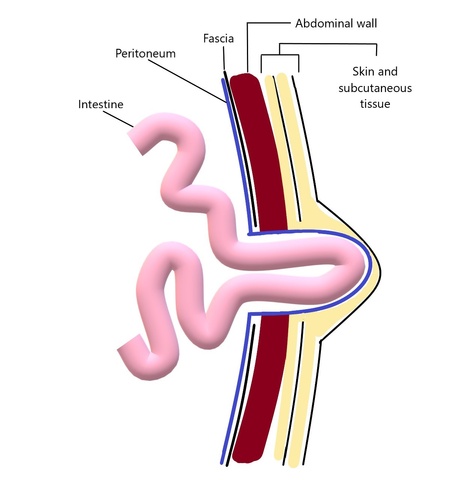
All newborns have a small umbilical defect (ring) at birth to allow passage of the umbilical vessels. This typically closes within days to weeks. But in approximately 20% of newborns, the ring fails to close, representing an umbilical hernia, which may present as a bulge or a palpable defect on physical examination. Some parents may describe an "outie" that is more apparent with crying, coughing, or Valsalva maneuver.
Risk Factors
Low birth weight infants (1500g or less) have a much higher risk of umbilical hernia.
The incidence of umbilical hernia is equal in male and female infants.
Umbilical hernia occurs more frequently in infants with thyroid abnormalities, Beckwith-Wiedemann Syndrome, and Trisomies 13, 18, and 21.
Complications
Incarceration is rare and occurs in less than 1% of all children, including premature infants. Infants under 6 months of age with 0.5-1.5 cm hernia defects are at the highest risk, but incarceration is still very uncommon.
Signs and symptoms of incarceration include a hard lump that cannot be pushed back in even when the child is relaxed. It may be tender to touch. The child may also have abdominal pain or vomiting. There may or may not be constipation or diarrhea.
Signs and symptoms of strangulation are the same as incarceration. The child may also have redness or darkness of the umbilical hernia, fever, or lethargy.